
Customer Retention Strategy: Why the Gold Is in the Customers You Already Have”
How to Grow a Business - The Growth Hack Series II

In our last edition, we saw the first Growth Path — Customer Experience.

Path 2, which we’ll see today, is not about finding new customers, neither is it about opening new markets or launching new products.
It is about unlocking MORE value from the customers you ALREADY HAVE.
We saw that the nucleus and foundation of any business model is their customers.
They pay the bills. They are literally gods!
They are the “seek ye first” of marketing. But a customer can soon leave you as easy as they joined you.
Acquiring a customer or attracting a client to your biz isn’t easy. It is costly.
PS: You need to have a customer base first before thinking of this Growth Path
THE COST OF THE NEW CUSTOMER

I want to say something uncomfortable here.
Many entrepreneurs are OBSESSED with acquisition, and they should be. Many are busy running ads, finding new markets, focusing on expansion and growth.
And yes, that’s important. But it’s also EXPENSIVE.
This makes you run a loss when they leave, and worse still, when they leave bad reviews. So this growth path is equally as important as acquiring a customer/client.
It is not enough to land them (we’re living in an explosion market where we’re presented with limitless choices daily, and where more products surge by the minute), so you have to keep ‘your own’ from looking elsewhere.
“In 2013, it cost Netflix around $45 to acquire a new customer in the United States, roughly what it costs to acquire an international customer today. But that number steadily rose throughout 2014 and 2015… Over the trailing twelve months (2016-2017), Netflix spent more than twice as much to acquire a U.S customer as it did four years before.”
Seeing the rising cost of Customer Acquisition, it is very important to keep one’s existing customer base.
Marketing research consistently shows it costs 5-7 times more to acquire a new customer than to retain or upsell an existing one. You are spending five to seven times more money chasing strangers when you have people who ALREADY TRUST YOU are sitting right there, waiting for you to offer them something else.
“The probability of selling to an existing customer is 60-70 percent. The probability of selling to a new prospect is 5-20 percent.” - Tiffani Bova
The best market is always the one you already have.
UNDERSTAND YOUR CLV
For those who don’t know what CLV is, I explained it in detail in the post below.

However, if you’re too hooked to break away from this piece, then I’ll patronize you.
CLV is simply the amount you’d make from one customer over a given period of time from their onboarding till they eventually leave.
So let’s say, you acquire a customer and they are likely to buy four times from you. If their first purchase covered the cost you used to acquire them, then their next 3 purchases are their CLV.
Normally, these things are easier to track now with CRM tools. But if you’re a small business or you have a very small customer base, all you need to do is ASK THEM.
You don’t know what the customer really needs because you are not them.
Don’t assume.
Ask them.
Ask for reviews.
Ask for feedback.
Send them surveys.
In this way, you’ll understand them better, and you’ll also know how best to serve them.
The reason your customers joined you in the first place will always determine whether you get to keep them or not. If they joined because you were cheaper, they’ll probably leave when someone cheaper than you surfaces. But if they joined because of your amazing customer service and value, you get to keep them.
And the sweet thing about a loyal customer base is that you get to cross and upsell them.
HOW *737# CHANGED BANKING IN NIGERIA
In 2013, Nigeria’s banking penetration rate was embarrassingly low for a country of 170 million people.
The banks knew this and wanted to solve it.
They did this the way they knew how to. They ran ads, opened new branches, printed flyers. But those methods weren’t working.
Then GTBank asked the most important question: what if the barrier wasn’t desire, but friction?
What if Nigerians WANTED to bank, but the process of banking was just too hard?
We know the drill already. Opening an account required forms, photographs, NEPA bills, a BVN you might not have yet, a physical visit to a branch that might be miles away, and oh! the branch might close before you even get there.
GTBank didn’t solve all of those problems. They just made one thing devastatingly simple.
Dial *737# and open a bank account. You don’t need internet or forms. Any phone, any network, anywhere you are in Nigeria, you can open an account.
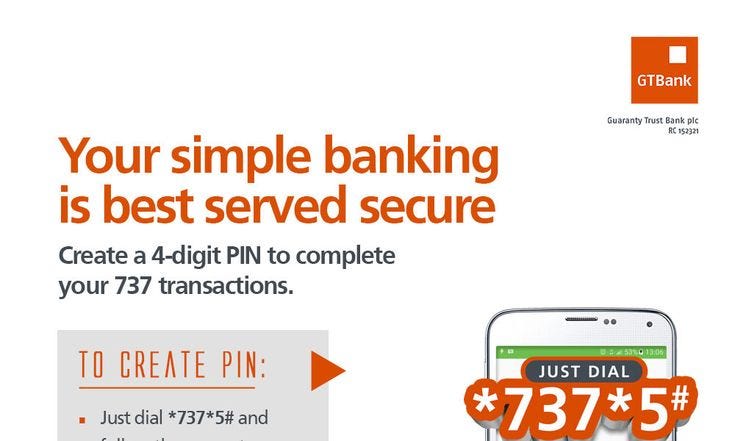
Within two years, mobile banking penetration in Nigeria jumped from 20% to 48%.
However, GTBank controlled 70% of airtime top-up transactions done through USSD. The market noticed and every bank scrambled to copy them.
You already have customers who want more from you. The question is what barriers YOU built that are stopping them or what question is it that you’re not asking them.
GTBank ran Growth IQ Path 2, but they ran it in the OPPOSITE DIRECTION.
They already had banking services. The customers wanted access but couldn’t get through the door. So GTBank removed the physical restriction.
Now here’s the question that should be keeping you up at night:
What is your *737# moment?
What service do you already have that your existing customers WANT but can’t easily access? What restriction did you put in place for internal convenience that’s actually costing you revenue? What would happen if you simply… removed it?
For a small restaurant, you only do dine-in but customers within a 5km or more would order from you weekly if you had a WhatsApp ordering system.
“Make new friends, but keep the old. One is silver, the other gold.” - UNKWOWN
The gold isn’t in a new customer. The gold is in the ones already in your ecosystem, asking for something you haven’t figured out how to give them yet.
THE FRAMEWORK: MINING YOUR EXISTING CUSTOMER BASE
Here’s how to run Path 2 for your own business:
STEP 1: MAP WHAT YOUR CUSTOMERS ARE DOING ANYWAY: What are your existing customers doing that relates to your product but they’re going elsewhere for? Are your clients hiring you for copywriting but going to another freelancer for strategy? Are your food customers buying from you but ordering drinks from another vendor?
STEP 2: IDENTIFY THE FRICTION: Why are they going elsewhere? Is it because you don’t offer it? Because you never promoted it? Because the process of getting it from you is complicated?
STEP 3: FIND YOUR SIMPLE UNLOCK: GTBank removed a location restriction. What single restriction can you remove that opens a flood of demand you already have?
STEP 4: PACKAGE IT SIMPLY: The simplicity of *737# is something to always emulate because the fewer the steps, the faster people adapt. Don’t build a complicated solution for a simple barrier.
STEP 5: TEST BEFORE YOU SCALE: GTBank tested USSD banking in a controlled environment. You don’t need to build the whole thing at once. Test the idea with 10 existing customers first (or with whatever appropriate ratio you operate). Just make sure to test it first.
FOR FREELANCERS WHO THINK THIS IS JUST FOR BUSINESSES
It isn’t.
It is about strategy and value, and it applies to you too.
One of the many ways I spend my week is to work for a US-based health company who treats people with special diseases and nerve tumors like Neurofibromatosis, Schwannomatosis, Café-du-lait spots, etc.
I started out as a social media strategist, but now I’ve worked many roles. Among which are SEO Content Writer, Technical SEO consultant (where I reworked the whole website’s URLs and restructured it, built an FAQ page and built a XML Sitemap for a Single Application Page (SAP) written in react.js among others). I’ve written email copies for an outreach to health providers, I’ve worked content strategy and done collabs with Ads specialist, I’ve also been put on the Video Editing team as an assistant (more like supervisor now).
This is me in slack at midnight arguing seriously on why I shouldn’t be asked to edit a video, seeing that the team has a video editor and I have ZERO video editing experience.
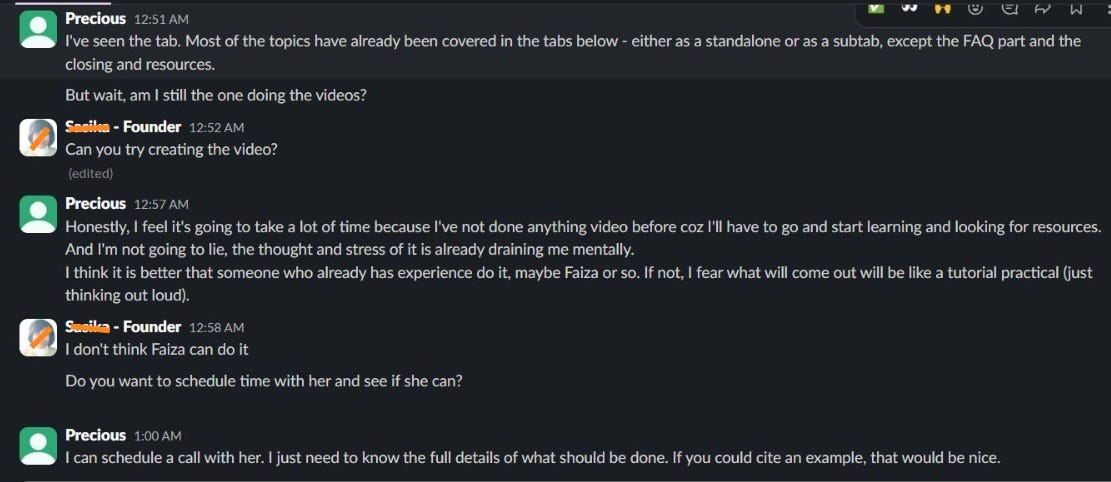
But the boss seemed to think that the editor with experience CAN’T do it, but me without experience CAN.
How did we get here? How did I get here?
It’s simple - VALUE. I got there because whatever task I was given, I executed and it made me RELIABLE.
That’s two things people pay you for - Value and Reliability.
And as a freelancer, that’s what you SHOULD BE SELLING to clients and not “I leverage… or I bridge the gap between innovation and confusion” or whatever garbage AI churns out these days.
That’s how you keep a client whether as a biz owner or as a service provider.
Com toda a humildade,
Precious Christopher
Marketing Psychology Analyst
Life and Marketing | Past Issues
Related reading: How Marketers Have ‘HACKED’ Our Brains | Exploiting Publicity Stunt: Lessons from OTIS and Hilda Baci